
Passing the RHCE: The Compounding Power of a Good System
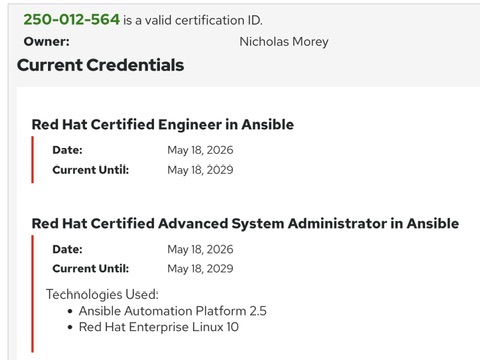
I recently took the AU 294 training and passed the EX 294 exam to become a Red Hat Certified Engineer (RHCE). I managed to do this just in time for Red Hat’s announcements regarding updates to their certifications. What was a blanket RHCE before means I now hold the title of Red Hat Certified Engineer in Ansible, which is level three out of five (with Specialist and Architect as levels four and five).
Reaching this milestone has me reflecting on the journey, and specifically on how finding a rhythm and following it over time is compounding.
The Backstory
Early in my career, I wanted so badly to complete some of the big-name certifications, like Cisco’s CCNA or the Red Hat Certified System Administrator (RHCSA). They eluded me for years. I had purchased the training for the RHCSA over a decade ago and never made it to the point of doing the certification exam.
In a previous post, I wrote about the iterative steps I took to find a format that works well for me. For a long time, I tried different methods, like scheduling exams arbitrarily at a future date by counting back how much of a self-paced course I was going to do each month, or trying full instructor-led training.
Now, I can say that in 18 months, I’ve completed three certifications, which, for me, is wild. I am also planning to complete two more this year. What I want to focus on today is how the system is compounding over time.
The System in Action
Here is the format I now follow once a quarter:
- The Format: A two-week, half-working-day, virtual instructor-led training.
- The Balance: The half-days are really nice because they allow me to maintain the rest of my responsibilities and my role during the rest of the day. I can take meetings with clients in the afternoon, respond to emails during breaks, and catch up on anything I need to prepare in the evening.
- The Exam Strategy: I book my exam for the following Monday after I’ve completed the training. This gives me a little bit of time over the weekend to catch up on any comprehensive labs from the course and practice.
- The Retake: If I find out I failed an exam, I will book a retake for the Monday after that. This gives me the rest of the week while it’s still fresh, and another weekend to practice and prep, before going into it again.
This system works really well for helping me to embrace the hard part of going through the coursework, doing the practice, and building that muscle memory in preparation for the exam.
Pacing and the Homelab
Following this system once a quarter naturally paces me. The exam and the preparation are quite taxing from a workload perspective. It requires extending myself out into pursuing the formal certification. During this time, my partner, Dani, helps out at home by taking on extra responsibilities to give me more space to focus on the training, and especially on the days when I take my exams.
Doing this four times a year allows me to spend collectively about a month pursuing the formal certifications. Then, I end up spending the other two months circling back to my comfort zone: experimenting in my home lab. I need that time doing less structured, more experimental, hands-on work to recharge and build up the tolerance to do the formal training again next time.
What’s Next
I’m looking forward to deciding on my next path. I think I want to pursue the Red Hat Certified Architect in OpenShift. I am only one exam away from being a Red Hat Certified Engineer in OpenShift.
I might continue down the Ansible route, and then pivot back to OpenShift. Since I get a ton of OpenShift experience just working in my home lab and speaking with clients, focusing on Ansible for my certifications helps round me out a little bit more.
Ultimately, I’m really grateful to have the opportunity to pursue these certifications, to be in a role that enables me to do it, to have Dani’s support at home, and to have the time and space to have found a system that works well for me.